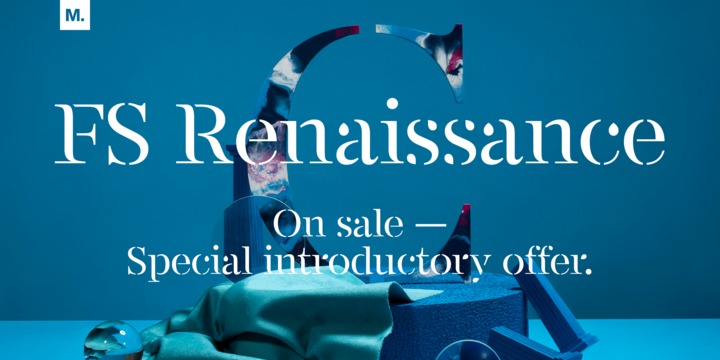
Download FS Renaissance Fonts Family From Monotype

Download FS Renaissance Fonts Family From Monotype


FS Renaissance is a display stencil typeface by the Monotype Studio. A collaboration between lettering artist and designer Craig Back and Creative Type Director Pedro Arilla, the single style font explores the intersection between art and design. With artist and designer working hand in hand, each letter was crafted as a standalone piece of art, while working harmoniously together as a functioning typeface. The typeface is inspired by the Renaissance period symbolised by flourishing progress in the arts, sciences, learning, and philosophy. The typeface is not a traditional stencil design: the cuts are not rigid but interactions that are hand crafted between each element, emphasising the idea of a typeface as a piece of art or sculpture. Pedro Arilla’s aim was to take the core DNA of Craig's lettering and apply it to a typographic base with a solid internal consistency, balanced with an external elegance. Pedro and Craig worked closely together to make sure the original concept was not compromised and this is reflected in the finished design which strikes the perfect balance between functionality and art.


Download FS Renaissance Fonts Family From Monotype


Popular posts from this blog

Download FF Kaytek Sans Fonts Family From FontFont

Download Now Server 1 Download Now Server 2 Download Now Server 3 Kaytek™ Sans is a fresh take on the correspondence typefaces of the 90s - which were originally designed for the demands of office environments. Just like its predecessors, this text typeface is robust and hard-working - meaning it works well in challenging design or printing environments - but it’s not without personality. Look closer at the lowercase g and a, especially in the italic, and you can see some unexpected elements of subversiveness within the design.  This blend of sturdiness and quirkiness means it’s just as relevant for information-heavy projects, such as annual reports, as it is in more expressive environments. Although first and foremost designed for text, Kaytek Sans’ details shine through in its heavier weights and larger sizes, meaning it also has display potential.  Every style of the typeface takes up exactly the same amount of space, thanks to the way Radek Łukasiewicz created the design. ...

Download Syphon Fonts Family From Indian Type Foundry

Download Now Server 1 Download Now Server 3 Download Now Server 2 Syphon is a family of sans serif fonts designed in the neo-grotesk style. It also includes a little kick, separating it from other typefaces in that genre: its diagonal letters feature stark contrast. The diagonals that are typically written with thin strokes in classic serif typefaces maintain thin strokes in Syphon as well, even in the family’s lightest weights. Speaking of weight, Syphon features ten font styles spread across five weights; these range from Thin through Bold. Every weight has both an upright font and an italic on offer. The italic fonts in Syphon are designed in the ‘oblique’ style. The fonts feature a tall x-height. Ascenders rise slightly above the tops of the capital letters, and the the numerals are slightly shorter than the uppercase letters’ height. Lines of text in Sypho...

Download Schotis Text Font Family From Huy!Fonts

Download Now Server 1 Download Now Server 3 Download Now Server 2 Schotis Text is a workhorse typeface designed for perfect reading on running texts. Its design is based in Scotch Roman 19th-century style but designed from scratch, with a more contemporary and not nostalgic look. It has seven weights plus matching italics, with 1100 glyphs per font, with a very extended character set for Latin based languages as well as Vietnamese, and shows all its potential with OpenType-savvy applications. Every font includes small caps, ligatures, old-style, lining, proportional and tabular figures, superscript, subscript, numerators, denominators, and fractions. The Scotch Romans were one of the most used letters during the 19th and early 20th century, but they don’t have their own place in the main typographical classifications. They appeared at the beginning of the 19th c...